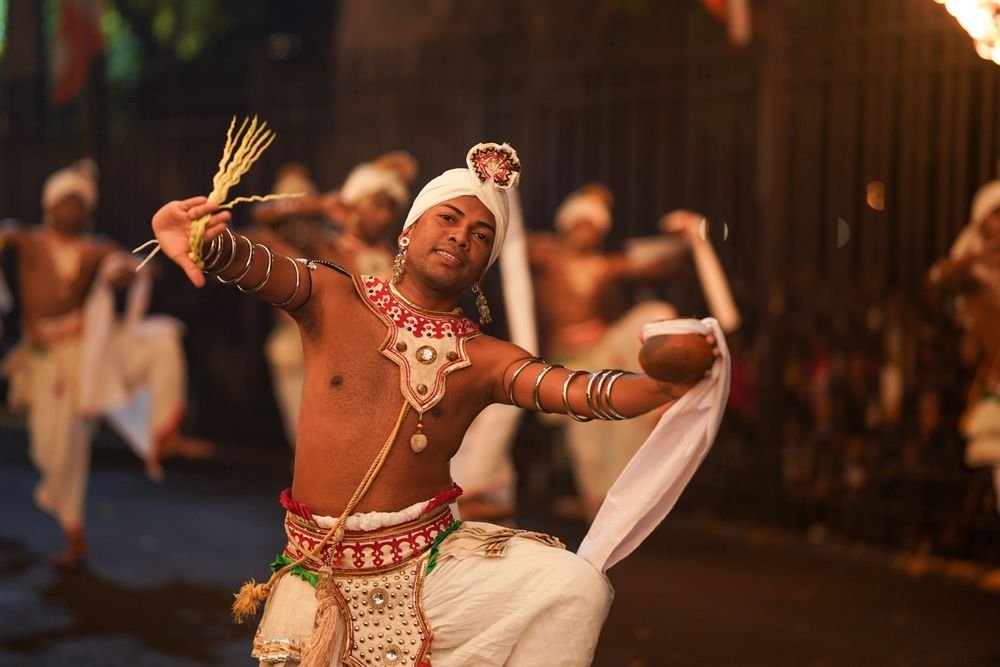

If you have never experienced the Kandy Esala Perahera, you are missing one of Asia’s most breathtaking cultural events.
Every August, the ancient hill city of Kandy transforms into something extraordinary. Thousands of people line the streets as elaborately decorated elephants stride past, fire dancers leap through flames, and traditional drummers fill the night with thundering rhythms. It is not just a parade. It is a living connection to centuries of Buddhist tradition.
The 2026 Perahera is coming, and if you are thinking about going, here is everything you actually need to know to plan your trip without the confusion.
History
The Kandy Esala Perahera festival traces back further than most people realize. The roots go to the 3rd century BC, when the Sacred Tooth Relic of Buddha was brought to Sri Lanka from India. For Buddhists, this wasn’t just any relic. It represented the living presence of Buddha and became the symbol of legitimate rule over the island.
What makes this history real is not just the age. It is the continuity. When you watch the Perahera, you are seeing rituals and sequences that have been performed year after year, generation after generation. The same paths through Kandy that hosted processions 300 years ago host them today. The same temple still houses the Sacred Tooth Relic in its inner chamber- Sri Dalada Maligawa, the Temple of the Tooth.
The modern festival evolved over centuries. By the time the Kandyan kingdom was at its height, the Perahera had become a massive annual event involving hundreds of performers and dozens of elephants.
When British colonial rule arrived, there were attempts to suppress it, but the festival survived. Today, it is Sri Lanka’s one of the most important cultural symbols and draws visitors from across the globe who come specifically to witness this spectacle.
Dates
Mark your calendar: The 2026 Kandy Esala Perahera runs from August 18 to August 28.
The festival always falls in August because it follows the lunar calendar. The actual start date aligns with the full moon (Esala Poya Day) of the lunar month of Esala. In 2026, that is August 18th, which is when the first Kumbal Perahera kicks off.
The first week tends to be smaller processions but not as crowded. The final week, especially August 23-27 during the Randoli Perahera, is when things reach peak intensity. More elephants, more dancers, grander decorations.
Here’s the breakdown of what happens each night:
- August 18-22: Kumbal Perahera (the five preliminary nights)
- August 23-27: Randoli Perahera (the five main nights which is the real main event)
- August 28: Diya-Kepeema Day Procession (the finale)
Time Table
Let us now also tell you the timetable of Kandy Esala Perahera 2026. Almost every year it starts in the evening and the timetable remains same.
The processions start in the early evening, usually around 6:30 PM to 7:00 PM. If you book a seat through an official gallery, arrival time varies depending on your ticket level, but typically you want to be in your spot by 5:00 PM at the latest. Some premium seats open two hours before the procession begins.
The procession itself moves through the route slowly. We are talking a full parade, not a quick walk-through. The entire sequence usually takes 2 to 3 hours to pass by any single viewing point, depending on which night it is.
Early nights (Kumbal) move faster because there are fewer performers. The final Randoli nights are longer because the processions are longer.
The procession typically winds up somewhere between 9:00 PM and 10:30 PM, but this varies.
Day Procession (August 28)
On the final day, there is a daytime procession. This usually runs from approximately 2:00 PM to 4:00 PM and is significantly shorter than the nighttime versions.
Route
The Kandy Esala Perahera follows a set route through the city and the same route it has followed for generations. This matters because knowing the route tells you where to position yourself for the best viewing experience.
The procession starts at the Sri Dalada Maligawa (Temple of the Tooth), which sits in the heart of Kandy on the shores of Kandy Lake. From here, the parade winds through the city streets in a specific sequence, covering approximately 5 kilometers total.
The Main Route:
The procession moves down Dalada Veediya (Temple Street) toward the south, then continues along DS Senanayake Veediya. This is one of the prime stretches for viewing because it is relatively wide and the procession moves at a steady pace here.
The parade continues through several key thoroughfares:
- JL Dias Mawatha
- Colombo Street
- Kandy Lake Circuit
The exact path returns toward the temple, effectively looping through Kandy’s central areas
Seats & Tickets
This is where things get real. If you want a guaranteed good view of the Kandy Esala Perahera, you need to book seats in advance. Trying to stand on streets and catch glimpses? That is possible, but also frustrating if your goal is to actually watch the procession unfold.
Official Ticket Booking:
The Temple of the Tooth (Sri Dalada Maligawa) and affiliated authorities manage official seat allocations. Several authorized booking platforms handle reservations:
- kandyperaherabookings.com – Official site with secure online booking
- Third-party platforms offering guaranteed seats with instant confirmation
- Hotel booking services – Many premium hotels in Kandy can arrange seats for their guests
Seat Categories & Pricing:
Seating is tiered by location and visibility:
Premium Gallery Seats (Rs. 5,000 – Rs. 10,000+)
- Best views, nearest to the procession path
- Comfortable seating arrangements
- Often include refreshments
- Book these 2-3 months in advance if possible
Standard Gallery Seats (Rs. 2,500 – Rs. 5,000)
- Good views, decent distance from the action
- Basic seating, no frills
Budget Seats (Rs. 1,000 – Rs. 2,500)
- Distant views or obstructed angles sometimes
- Standing room or bench seating
Conclusion
In 2026, Kandy Esala Perahera festival happens August 18-28. If you can make those dates work, the experience will stay with you long after the last elephant has walked past and the final drummer has headed home. And if you have not booked your tickets already, do it right now. Also, book your accommodation as soon as possible.

Editorial Staff’s at Sri Lanka Travel Helper are experts in Sri Lanka tourism.